


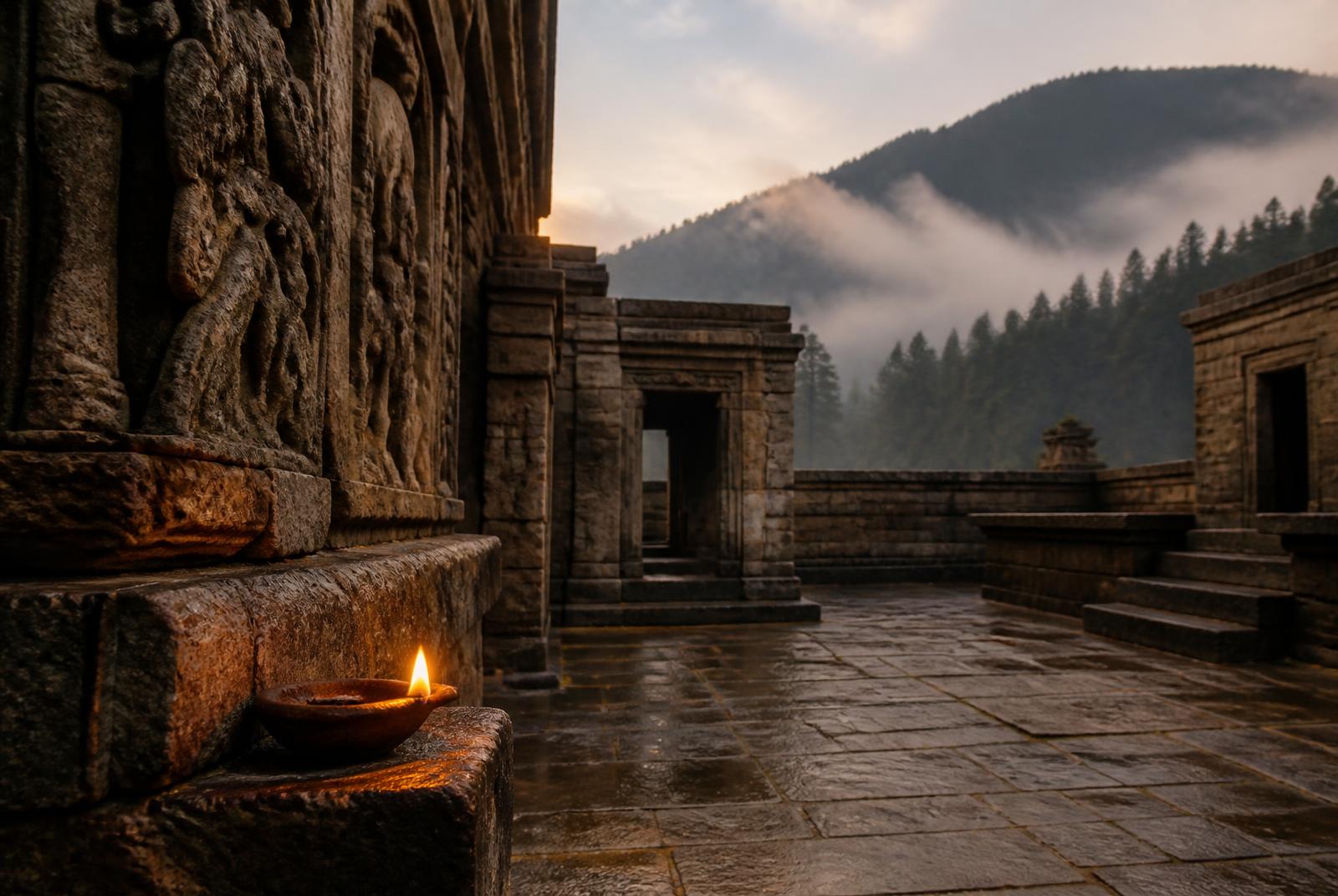
Tantra: The Science of Being Human
Part 01 / 15 · 10-12 minutes
For centuries, the word Tantra has been surrounded by mystery. For some, it means secret rituals. For others, it means sexuality. Some imagine supernatural powers, magical practices or hidden ceremonies.
And because of this, one of the most sophisticated spiritual and philosophical traditions of India is often reduced to something it was never meant to be.
But what if we stepped away from all of those assumptions?
What if we went back to the question that sits underneath the tradition?
Not: “What can Tantra make you do?”
But: “What was Tantra trying to understand about being human?”
That question takes us somewhere much deeper.
It takes us to consciousness. To the body. To breath. To perception. To energy. To desire. To relationship. To sound. To attention.
And ultimately, to the question that human beings have been asking for thousands of years:
Who am I?
Before Tantra Became a Word, There Was a Human Being Asking Questions
Imagine a human being living centuries ago.
There is no neuroscience. No MRI. No modern psychology. No endocrinology. No laboratory equipment capable of measuring neural activity.
And yet the human experience is exactly as complex as it is today. The person still experiences fear. Love. Desire. Grief. Pleasure. Anxiety. Attention. Dreams. Breath. Thought. Intuition. Connection. Disconnection. And consciousness.
The ancient seeker had the same fundamental mystery that we still have today: what is happening inside me? And perhaps even more importantly: who is experiencing all of this?
The Tantric traditions emerged within a much larger landscape of Indian spiritual and philosophical inquiry. But Tantra took a distinctive direction.
Instead of seeing ordinary human experience only as something to escape, suppress or reject, Tantric traditions explored whether human experience itself could become a doorway to understanding consciousness.
The body could be observed. The breath could be observed. The mind could be observed. Desire could be observed. Sound could be observed. Attention could be trained. And consciousness itself could become the subject of investigation.
This was a profound shift. The human being was no longer simply being told what reality was. The human being was being invited to look.
The Story Moves to Kashmir
One of the most important centres for the development of Shaiva philosophical and contemplative traditions was the Kashmir Valley.
Over centuries, Kashmir became home to sophisticated traditions of philosophy, meditation, ritual and the exploration of consciousness. It was here that a remarkable intellectual and spiritual culture developed around the nature of Shiva, Shakti, consciousness and human experience.
And at the beginning of the Kashmir Shaiva tradition stands a name that has become inseparable from one of its foundational texts: Vasugupta.
The Story of Vasugupta
According to traditional accounts, Vasugupta received the Shiva Sutras through a revelatory experience. The traditional story describes Shiva revealing the teachings to Vasugupta, sometimes associated with a dream or divine instruction directing him toward the place where the teachings could be found.
Whether we understand this story literally, symbolically or spiritually, the importance of the story lies in what came from it.
The Shiva Sutras became one of the foundational texts of Kashmir Shaivism. They were expressed through concise statements rather than long philosophical explanations. Short teachings. Dense ideas. Almost like compressed instructions for contemplation.
They were not formulas for magical powers. They were pointers toward an investigation of consciousness.
- ·What is awareness?
- ·What limits human experience?
- ·What is the nature of perception?
- ·What is the relationship between the individual and the whole?
- ·How can consciousness recognize itself?
These questions became central to the philosophical world that developed around Kashmir Shaivism.
A Different Kind of Spiritual Question
There is an important difference between being told what to believe and being invited to investigate your own experience. A belief can be inherited. An experience has to be encountered.
This is where the Tantric approach becomes fascinating.
The practitioner could sit. Observe the breath. Watch the mind. Repeat a mantra. Focus attention. Become aware of sensation. Observe desire. Enter stillness. Listen to sound. And notice what happens.
The practice becomes a form of inquiry.
Not: “Do I believe this?” But: “What happens when I actually practice this?”
This distinction is central to understanding why Tantra developed such a vast collection of methods. The tradition was not only interested in explaining reality. It was interested in experiencing it.
The Human Being Became the Laboratory
This may be one of the most powerful ways to understand the Tantric approach. The human being became the laboratory.
The body became a field of observation. The breath became something that could be explored. Attention became something that could be trained. The mind became something that could be witnessed. Emotion became something that could be experienced without immediately becoming identified with it. Sound became something that could influence attention. Stillness became something that could be entered rather than merely imagined.
The practitioner was exploring the relationship between:
- ·Body
- ·Breath
- ·Mind
- ·Attention
- ·Energy
- ·Experience
- ·Consciousness
And gradually, a remarkable possibility emerged.
Perhaps human consciousness is not something that simply happens to us. Perhaps our relationship with consciousness can be explored. Perhaps attention can be trained. Perhaps perception can change. Perhaps our experience of ourselves can change. And perhaps there is something deeper beneath the constantly changing contents of the mind.
Shiva: The Question of Consciousness
At the centre of Kashmir Shaivism is Shiva. But to understand this correctly, we should not reduce Shiva only to an image of a deity sitting in meditation.
Within the philosophical framework of Kashmir Shaivism, Shiva represents the fundamental principle of consciousness. The awareness through which experience is possible. The consciousness that knows. The presence behind perception.
And then comes another principle: Shakti.
If Shiva represents consciousness, Shakti represents the dynamic power of consciousness. Movement. Expression. Creation. Manifestation. Experience.
This relationship between Shiva and Shakti becomes one of the central ideas of Tantric philosophy. Consciousness and its power to express itself. Stillness and movement. Awareness and experience. Potential and expression.
The Universe Was Not Outside Consciousness
This led to a radical philosophical possibility.
What if consciousness and life were not fundamentally separate? What if the world was not something completely disconnected from the divine? What if existence itself could be understood as an expression of consciousness?
This is one of the foundations of the non-dual perspective associated with Kashmir Shaivism. The goal was not necessarily to escape the world in order to find the divine somewhere else.
Instead, the practitioner was encouraged to recognize consciousness within experience itself. In the body. In perception. In thought. In relationship. In sound. In nature. In stillness. In movement.
This is where Tantra becomes very different from the stereotype that surrounds it. It does not simply say: “Leave life behind.” It asks: “Can you become conscious within life?”
But How Do You Study Consciousness?
If consciousness is the subject of investigation, how do you study something that cannot simply be held in your hands? You cannot place consciousness on a table. You cannot look at it directly like an object.
So the Tantric traditions developed maps, symbols and practices for working with human experience. They explored the body. They explored breath. They explored sound. They explored attention. They explored meditation. They explored subtle experience.
And eventually, an elaborate language emerged.
- ·Chakras
- ·Nadis
- ·Prana
- ·Kundalini
- ·Mantra
- ·Mudra
- ·Bandha
- ·Pranayama
- ·Yantra
- ·Nada
These words would eventually become some of the most recognizable concepts associated with Indian spiritual traditions. But there is a problem. Many of them are now surrounded by modern interpretations, commercial claims and supernatural stories.
So before we decide what these words mean, we need to understand why these maps were created in the first place.
The Body Was Not an Obstacle
In many modern interpretations of spirituality, the body is sometimes treated as something inferior to the mind or soul. Tantric traditions offered a different possibility.
The body could become a vehicle of awareness. Breath could become a bridge. Sensation could become information. Attention could become a practice. Movement could become meditation. Sound could become concentration.
The body was not necessarily something that had to be rejected. It could become part of the path. This is one reason Tantra developed such a rich relationship with embodied practices.
The question was not simply “How do I escape being human?” It became “How deeply can I understand being human?”
And Then Came the Question of Energy
Human beings have always experienced something we describe through words such as vitality, life force, intensity, exhaustion, excitement and presence. Traditional Indian systems developed their own vocabulary for this dimension of experience.
One of the most important terms is Prana. Prana is traditionally understood as vital life force and is closely associated with breath and living processes.
From this broader framework emerged ideas about subtle pathways and centres of experience. The Nadis. The Chakras. The movement of Kundalini.
These ideas belong to a traditional subtle-body framework. They should not simply be equated with modern anatomical structures. A chakra is not literally an endocrine gland. A nadi is not literally a nerve. The ancient system was using a different language to describe dimensions of human experience.
And that distinction matters. Because we do not need to turn ancient wisdom into modern science in order to respect it. We can study it on its own terms, and then ask where meaningful conversations with modern psychology, physiology and neuroscience may exist.
Tantra and the Whole Human Being
This is perhaps where Tantra becomes most relevant to modern life. Human beings are not only intellectual. We are physical. Emotional. Psychological. Relational. Sensory. Creative. Social. And conscious.
Any system that tries to understand the human being while ignoring half of human experience will always remain incomplete.
Tantric traditions were willing to look at dimensions of life that other spiritual approaches sometimes treated with suspicion. Desire. Pleasure. Relationship. Sensuality. The body. Emotion.
But this does not mean Tantra was simply a sexual philosophy. That is one of the greatest modern misunderstandings.
Tantra and Sexuality
Tantra is not dependent on sexuality or sensuality.
Sex was one of the human experiences that some Tantric traditions were willing to explore consciously, but it was never the entirety of Tantra.
Sexuality can be a powerful form of human communication. A meeting between two people. A space involving vulnerability, trust, intimacy, desire and presence. For partners who choose to share their lives, it can become part of the process of understanding one another - physically, emotionally and psychologically.
The Tantric question is therefore not simply “How can I experience more pleasure?” It is closer to “Can this human experience become conscious rather than unconscious?”
Can intimacy become connection rather than consumption? Can desire be understood rather than blindly followed? Can two people remain present with one another? Can relationship become a space for awareness?
These questions are much larger than sexuality itself. And they return us to the central Tantric concern: consciousness within human experience.
The Practices Were the Technology
Once the human being became the laboratory, practices became necessary. How do you train attention? How do you work with breath? How do you stabilize the body? How do you concentrate? How do you quiet mental activity? How do you use sound? How do you work with symbolic forms? How do you observe the subtle dimensions of experience?
This is where practices such as these became important within different streams of Indian contemplative traditions:
- ·Mantra
- ·Mudra
- ·Bandha
- ·Asana
- ·Pranayama
- ·Meditation
- ·Visualization
- ·Yantra
These practices were not created simply to make spirituality mysterious. They were methods. You practice. You observe. You refine. You experience. You understand.
Information is the beginning. Experience is the teacher.
From Kashmir to a Philosophy of Recognition
As the Kashmir Shaiva traditions developed, the inquiry became increasingly sophisticated. Thinkers such as Utpaladeva and later Abhinavagupta developed and systematized profound philosophical approaches to consciousness, perception, reality and liberation.
One of the important philosophical streams became known as Pratyabhijna - recognition. And the word recognition changes the entire journey.
Because perhaps liberation is not simply about becoming something you are not. Perhaps it is about recognizing something that has always been present.
The question changes from “How do I become divine?” to “What is already here that I have failed to recognize?”
This is where the story of Tantra becomes much more than ancient history. It becomes a question about you.
Why Does This Matter Today?
We live in a world surrounded by information. We understand the brain better than any previous generation. We can study the nervous system. We can investigate psychology. We can observe neural activity. We can measure physiological responses.
And yet some of our deepest human questions remain unchanged.
- ·Why do we suffer?
- ·Why do we repeat patterns?
- ·Why do we disconnect from ourselves?
- ·Why do relationships become difficult?
- ·Why does the mind constantly search for something?
- ·Why can we have everything externally and still feel empty internally?
- ·Why is it so difficult to simply be present?
These are not ancient questions. They are human questions.
And that is why Tantra remains interesting. Not because everything ancient was automatically correct. Not because ancient practitioners possessed modern scientific knowledge. But because they were deeply interested in something we are still trying to understand: the human experience of being conscious.
Tantra Was Not a Shortcut to Magic
Perhaps this is the idea we should leave behind at the end of this first chapter. Tantra does not need magical promises to be extraordinary. It does not need supernatural claims. It does not need to be reduced to sexuality. It does not need to be hidden behind complicated language.
Its questions are already powerful enough.
- ·What is consciousness?
- ·What is the relationship between consciousness and energy?
- ·How does attention shape experience?
- ·How does breath influence our state?
- ·How does sound influence attention?
- ·How can the body become a pathway toward awareness?
- ·How can desire become something we understand rather than something that controls us?
- ·How can relationship become conscious?
And ultimately: who are we beneath the constantly changing activity of the mind? These questions are where the journey begins.
The Beginning of a Much Larger Map
The practitioners of these traditions did not stop with philosophy. They began developing maps of the human experience. They described centres of subtle experience. They described pathways. They described movements of vital energy. They developed practices of breath, sound, concentration, meditation and visualization.
They explored the relationship between consciousness and the body. They explored the relationship between awareness and energy. And slowly, an entire language of human transformation emerged.
Chakras. Nadis. Kundalini. Shiva. Shakti. Nada. Yantra. Mantra. These are not separate ideas. They belong to a much larger story.
And if we want to understand them properly, we have to go back to the beginning. Because before we ask “What is a chakra?” we should first ask “Why did the Tantric traditions need a map of the human being at all?”
That is where our next chapter begins.